


1 / 2
MigraIso™︎ Tissue Migrasome Purification Kit
PRT001S
For purifying migrasomes from crude preparations derived from tissue single-cell suspensions, using an endomembrane-recognition reagent and magnetic beads to reduce debris and endomembrane contaminants introduced during tissue dissociation.
 Product manual
Use this page for product selection and experiment planning. Consult the PRT001 series manual for the full procedure and limitations.
Tissue dissociation generates substantial cell debris and endomembrane material. The kit combines an endomembrane-recognition reagent with magnetic beads to remove these contaminants from crude migrasomes and obtain a purer tissue migrasome preparation.
Laboratory personnel must establish a tissue-specific dissociation method and prepare a single-cell suspension. Dissociation conditions can affect migrasome recovery and contamination.
Components and storage
| Component | Qty. | Storage |
|---|---|---|
| Purification reagent A | PRT001: 250 μLPRT001S: 50 μL | Purification reagent A may be stored at -20°C to extend its shelf life to 12 months. Avoid repeated freeze-thaw cycles. |
| Magnetic bead suspension B | PRT001: 5 mLPRT001S: 1 mL | Store at 4°C, do not allow it to freeze, and mix thoroughly before use. |
| Instruction manual | PRT001: 1 copyPRT001S: 1 copy | Store as directed in the product manual. |
PRODUCT FEATURES
Product advantages
Designed for tissue samples
Purifies migrasomes from the abundant cell debris and intracellular membrane components generated during tissue dissociation.
Magnetic-bead negative-selection purification
Antibodies recognizing intracellular membranes work with magnetic beads to remove contaminants and obtain tissue migrasomes of higher purity.
Compatible with multiple tissue types
Reference purification conditions have been established for mouse lymph nodes, spleen, 4T1 solid tumors, and other tissues.
Effective purification
Recovered migrasomes are enriched for markers including ITGAV, NDST1, and Rab8a, with no Calnexin or H3 contamination detected.
EXPERIMENTAL WORKFLOW
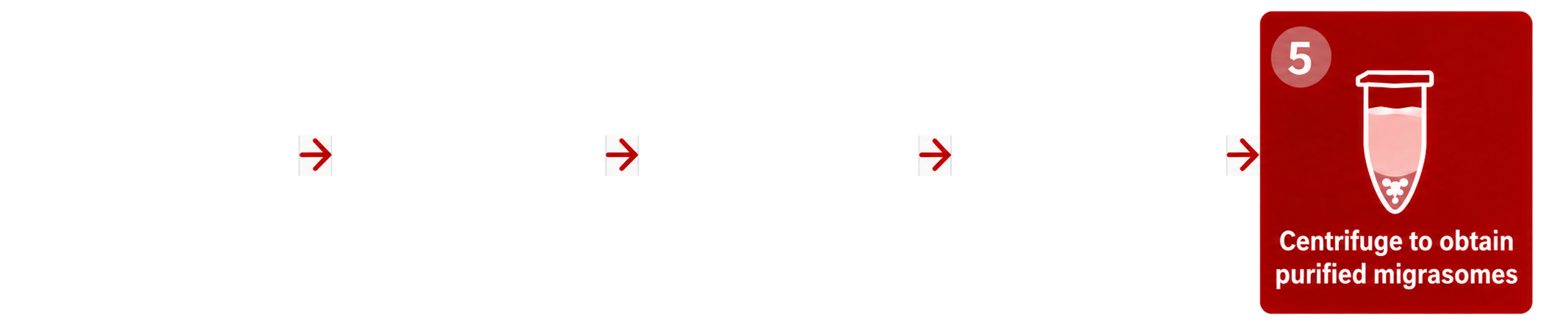
Workflow
EXAMPLE RESULTS
Example results
1 / 2
FAQ
Frequently asked questions
Does the kit include tissue-dissociation reagents?
No. Laboratory personnel must establish a tissue-specific dissociation method and prepare a single-cell suspension.
How much crude material is required per test?
The current specification is 100 μg of tissue migrasome crude preparation per test. PRT001 and PRT001S provide 50 and 10 tests, respectively.
Is the amount of purification reagent A fixed?
No. The general workflow uses 5 μL per 100 μg of crude material. The manual reports tested ranges of 2–4 μL for mouse lymph node and spleen and 5–10 μL for mouse 4T1 solid tumor; other tissues require optimization.
What factors affect recovery?
Tissue type, dissociation method, crude contamination, purification-reagent amount, and input all affect recovery. The manual reports tested recoveries of approximately 5%–25%, which should not be treated as a guarantee for every tissue.
How should purified samples be stored?
For analyses of contents, such as nucleic acid extraction, western blotting, or mass spectrometry, store the pellet at -80°C after supernatant removal. For morphology, number, surface properties, or activity studies, storage at 4°C is recommended; the manual reports little effect on morphology and number within one week. Freezing at -20°C or -80°C causes aggregation and some rupture, so a preliminary experiment to evaluate its effects is recommended if freezing is necessary.
Manual and COA
RELATED PRODUCTS


