


1 / 11
MigraPrep™︎ - Cultured-Cell Migrasome Production and Purification Kit (Density Gradient)
PRC001
For cultured-cell migrasome production, differential-centrifugation enrichment, and density-gradient purification, supporting migrasome counting, protein and RNA analysis, and cell-function studies.
 Product manual
Use this page for product selection and experiment planning. Consult the PRC001 series manual for the full procedure and limitations.
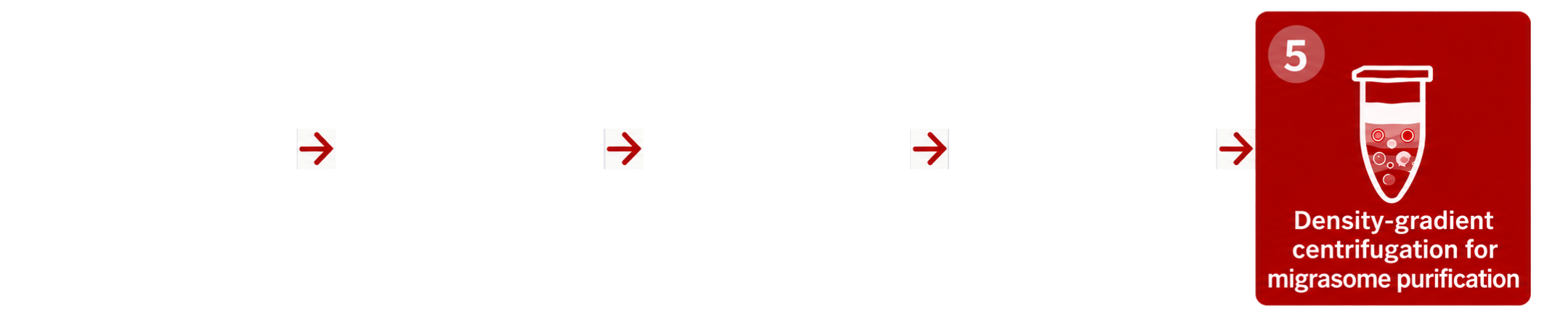
The kit is intended for producing and isolating migrasomes from cultured cells. The workflow covers culture-surface preparation, cellular migrasome production, differential-centrifugation enrichment, and density-gradient ultracentrifugation.
It is suited to migratory adherent cell lines or primary cells. Migratory capacity, culture density, extracellular matrix, and detachment conditions can all affect output and purity, so small-scale optimization should precede production.
Components and storage
| Component | Qty. | Storage |
|---|---|---|
| Purification reagents A–I | PRC001: 5.0 mL eachPRC001S: 1.0 mL each | Store at 4°C. |
| Matrix solution J | PRC001: 1.5 mLPRC001S: 300 μL | Store at -20°C after receipt. |
| Diluent K | PRC001: 50 mLPRC001S: 10 mL | Store at 4°C. |
| Resuspension solution L | PRC001: 100 mLPRC001S: 20 mL | Store at 4°C. |
PRODUCT FEATURES
Product advantages
Integrated production and purification
Covers cell seeding, migrasome production, crude isolation, and density-gradient purification in a complete preparation workflow for cultured-cell migrasomes.
Conventional density-gradient purification
Density-gradient ultracentrifugation separates migrasomes from cell debris, organelles, and other impurities to obtain purified samples with low protein contamination.
Compatible with multiple cultured cell types
Suitable for migratory adherent cell lines and primary cells, enabling migrasome production conditions to be established for different cells.
Broad downstream applications
Purified samples can be used for migrasome counting, protein and RNA analysis, and cell function assays.
EXPERIMENTAL WORKFLOW
Workflow
EXAMPLE RESULTS
Example results
1 / 4
FAQ
Frequently asked questions
Which cells are suitable?
Migratory adherent cell lines and primary cells may be evaluated. Suspension cells are generally not recommended unless adhesion and migration are enabled by a validated extracellular matrix or another suitable approach.
How should seeding density and production time be selected?
A confluence of 20%–40% at harvest is recommended, with a lower density for faster-migrating cells. A production time of 12–16 hours is generally recommended.
Is an ultracentrifuge required?
Density-gradient purification requires a swinging-bucket ultracentrifugation system capable of 150,000×g. The gradient may be proportionally scaled for compatible tube systems as directed in the manual.
How much crude material can be loaded per gradient?
Approximately 100 µg is recommended as a starting load. Crude-sample purity can substantially change practical capacity, so the load should be adjusted according to separation performance.
How should purified migrasomes be stored?
For nucleic-acid or protein-content studies, the pellet may be stored at -80°C after supernatant removal. For morphology, count, surface-property, or activity studies, short-term storage at 4°C is recommended. Freezing can cause aggregation and some rupture. Preliminary experiments are recommended if freezing is necessary.
Manual and COA
RELATED PRODUCTS


