


1 / 4
MigraIso™︎ - Human Blood Total Migrasome Extraction Kit
PRHB001
For extracting total cell-derived migrasomes from human peripheral blood or plasma for migrasome counting, protein and RNA analysis, and cell-function studies.
 Product manual
Use this page for product selection and experiment planning. Consult the PRHB001 series manual for the full procedure and limitations.
Components and storage
| Component | Qty. | Storage |
|---|---|---|
| Promoting reagent A | PRHB001: 32 μLPRHB001S: 8 μL | Store at -20°C. This reagent is a suspension; visible sediment is normal and the reagent must be mixed thoroughly before use. |
| Buffer B | PRHB001: 20 mLPRHB001S: 5 mL | Store at 4°C. Do not freeze or allow the reagents to ice. |
| Diluent C | PRHB001: 80 mLPRHB001S: 20 mL | Store at 4°C. Do not freeze or allow the reagents to ice. |
| Purification reagent D | PRHB001: 120 μLPRHB001S: 30 μL | Store at 4°C. Do not freeze or allow the reagents to ice. |
| Purification reagent E | PRHB001: 20 μLPRHB001S: 5 μL | Store at 4°C. Do not freeze or allow the reagents to ice. |
| Magnetic bead suspension F | PRHB001: 600 μLPRHB001S: 150 μL | Store at 4°C. Do not freeze or allow the reagents to ice. |
| 15 mL centrifuge tubes | PRHB001: 20 tubesPRHB001S: 5 tubes | Store as directed in the product manual. |
| Instruction manual | PRHB001: 1 copyPRHB001S: 1 copy | Store as directed in the product manual. |
PRODUCT FEATURES
Product advantages
Fast and efficient
A simple procedure efficiently isolates and purifies migrasomes from human peripheral blood or plasma.
Low contamination, consistent quality
Effectively reduces impurities and protein contamination to obtain migrasomes of consistent quality.
Broad downstream applications
Supports migrasome counting, protein and RNA analysis, and cell function studies.
Low equipment requirements
Requires only a benchtop refrigerated high-speed centrifuge; no ultracentrifuge is needed
SAMPLE REQUIREMENTS
Sample requirements
Freshly collected whole blood is preferred. Sodium citrate is the recommended anticoagulant; EDTA-anticoagulated samples can also be processed, but platelet-fragment contamination may increase.
Fresh or -80°C-frozen plasma samples can be processed. Differences in migrasome loss during plasma collection at different centrifugation speeds, together with increased platelet fragments after freeze-thawing, may affect kit yield and recovery.
This kit is not suitable for plasma obtained using blood-filtration membranes. Serum is outside the sample scope listed in this manual.
EXPERIMENTAL WORKFLOW
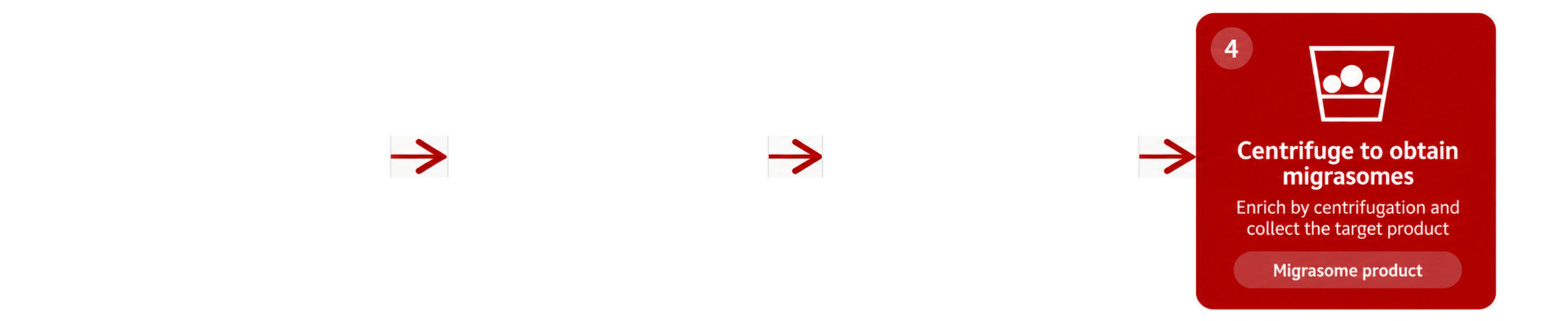
Workflow
EXAMPLE RESULTS
Example results
1 / 4
Figure 1. Fluorescence confocal images before and after sorting show effective removal of impurities such as platelets. WGA: migrasome marker (WGA also stains platelets, so platelet removal should be as complete as possible); CD41: platelet fragments; CD235a: erythrocytes; CD66B: neutrophils.
FAQ
Frequently asked questions
Which samples are suitable?
Human peripheral blood or plasma is suitable, and fresh plasma is recommended. Samples stored at -80°C may be used, but freeze-thawing and plasma-preparation conditions may affect output and yield. Plasma obtained through blood-filtration membranes is not suitable.
Which anticoagulant is recommended?
The manual specifies sodium citrate anticoagulant collection tubes. EDTA-anticoagulated blood has been tested but showed more platelet contamination than sodium citrate. Other anticoagulants have not been tested; evaluating their suitability before use is recommended.
How should samples, diluent, and blocked tubes be prepared before extraction?
Fresh plasma is recommended. Fresh peripheral blood intended for plasma preparation must not be stored for more than 4 hours before extraction. Plasma stored at -80°C may be used, but freezing and thawing and plasma-preparation conditions may affect yield and recovery. Prepare plasma diluent at B:C=1:9, using a total volume equal to three times the plasma volume plus 1.5 mL. Mix at plasma:diluent=1:3 and reserve 1.5 mL for subsequent resuspension. Save the supernatant from manual step 1-4. Before manual step 1-5, leave it in a low-binding tube for at least 1 minute, remove it, briefly centrifuge, and aspirate as much residual liquid as possible.
How can platelet contamination be reduced?
Minimize mechanical disturbance when handling peripheral blood. Conduct low-speed centrifugation for plasma preparation at room temperature and keep post-enrichment operations at 4°C. If contamination is severe, repeat the purification steps as directed and consider reducing purification reagent D and magnetic bead suspension F.
How should the centrifuge rotor be selected?
Use a swinging-bucket rotor when practical for low-speed plasma preparation. For crude extraction at 20,000×g, a fixed-angle rotor with an angle of 45° or greater is recommended to help the pellet collect at the tube bottom.
How is one test defined in the specification?
The manual defines one test as a crude preparation with total OD280=100, calculated as A280 multiplied by sample volume in µL. PRHB001 and PRHB001S provide 20 tests and 5 tests, respectively.
Manual and COA
RELATED PRODUCTS


